Efficiency Is Not Destiny: What Wall Street's AI Panic Gets Wrong About the Next 24 Months
This post is inspired by the episode, Schrodingers Apocalypse of the AI Daily Brief.
Efficiency Is Not Destiny: What Wall Street's AI Panic Gets Wrong About the Next 24 Months
This week, a speculative research piece called "The 2028 Global Intelligence Crisis" ripped through Wall Street and sent IBM down 13% in a single day. The thesis: AI gets so good that companies replace workers en masse, consumer spending collapses, and the economy spirals.
The same week, legendary Oaktree Capital founder Howard Marks reversed his position on AI. In a memo called "AI Hurdles Ahead," the same investor who once questioned the hype now writes that AI's potential is "more likely underestimated today than overestimated."
So which is it? The end of everything, or the beginning of something enormous?
Both camps are missing the most important variable in the equation. And a story from our CEO's recent travel disaster explains why.
Stranded in Brazil With Two Kids and a ChatGPT Subscription
Our CEO's family was flying home from Uruguay when a bomb cyclone killed their flights, Delta rerouted them through Sao Paulo, a generator failed mid-air, and they made an emergency landing in Manaus, the capital of the Amazon.
He used AI constantly during the ordeal. Translation in a language he barely speaks. Safety profiles of unfamiliar neighborhoods. Rental car availability. Whether an Airbus A330 can fly on one generator (it can, barely reassuring).
AI was genuinely useful. But every pivotal moment in those 20 hours came down to a human being deciding whether to follow the rules or break them for his family.
The Delta attendant in Montevideo who refused to check them in because their final destination was New York, even though the storm had passed and they had two stops in between. She followed policy. It was the wrong call.
The Diamond line rep who hustled to rebook them through Philadelphia when no one else could find a route. She broke protocol. It was the right call.
The hotel staff in Manaus who overlooked that the kids weren't technically on the reservation and rushed them into a room before check-in time. Discretion, not efficiency.
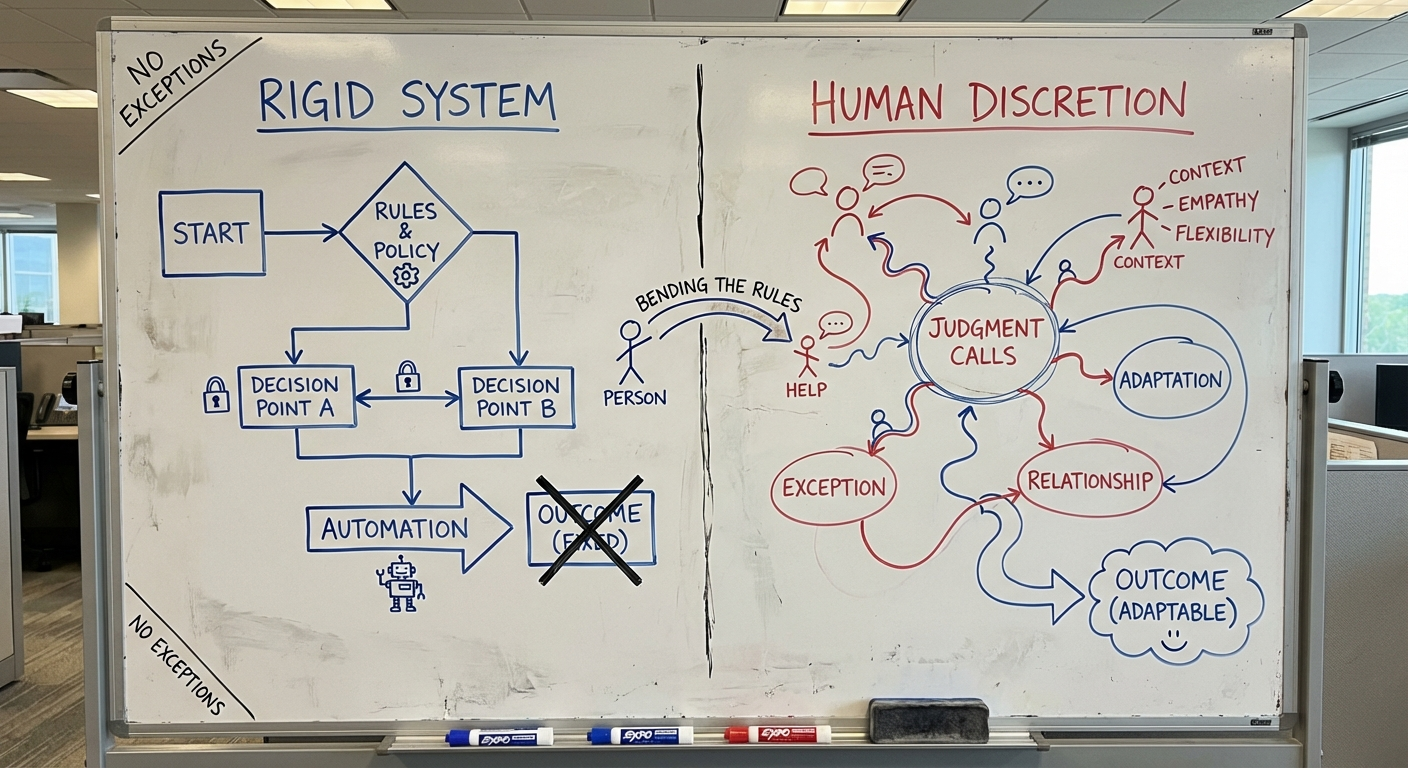
Here is the point: human systems are built with an implicit assumption that rules will be imperfectly followed. That imperfection is a feature. The whole system would be more brittle if everyone followed the rules perfectly all the time.
A world where AI agents enforced every policy with zero discretion would be, in many real-world contexts, much worse than what we have today.
The Efficiency Gospel and Its Discontents
Most AI analysis, on both the doom side and the abundance side, rests on an assumption so deeply embedded that almost nobody questions it: because markets reward efficiency, efficiency is inevitable.
Call it the efficiency gospel. If AI can do something cheaper and faster, it will do that thing, and the human who used to do it will be displaced. The Rinni Report is the efficiency gospel taken to its logical extreme. So is every "AI will replace X million jobs" headline.
But efficiency is only one market force. It is not even the most powerful one.
Markets don't exist to be efficient. Markets exist to serve human preferences. And human preferences are weird, irrational, and stubbornly resistant to optimization.
Delta doesn't automate the Diamond Medallion phone line. The Diamond line is the product. People pay a premium for guaranteed access to favorable human discretion. Automate that, and you have eliminated the thing people are paying for.
The entire premium loyalty economy, status tiers, concierge services, white-glove anything, is a multi-billion dollar bet that people will pay for the possibility of being an exception. The chance that someone will look at your situation and deviate from the script.
This is not a minor market force. It is enormous. And the AI displacement models don't account for it at all.
What Howard Marks Got Right (and What He Missed)
Marks identifies three inflection points that make AI different from every prior technology wave.
First, the pace. Nothing has ever been adopted this fast. AI is "able to change the world at a speed that approaches instantaneous, outpacing the ability of most observers to anticipate or even comprehend."
Second, the capability jump. We moved from chat AI to tool-using AI to autonomous agents faster than anyone predicted. At level three, the user gives AI a goal and the agent designs the plan, does the work, checks it, and delivers a finished product. That is labor replacement at the task level.
Third, autonomy. Unlike prior technologies that required human direction at every step, AI can operate independently. That changes the calculus for every organization.
Marks is right about all three. Where his analysis stops short is the same place most Wall Street analysis stops: at the capability layer. The models can do the work. But can your organization actually deploy them? Can your teams identify which tasks to delegate? Can your culture absorb the change without breaking?
Those are not technology questions. Those are readiness questions. And the gap between what AI can do and what companies are prepared to let it do is where the real story lives.
We see this gap in every engagement at Superintelligent. Our voice AI interviews hundreds of employees across departments, and the pattern is consistent: roughly two-thirds of what surfaces is about culture, process design, and organizational infrastructure. Not about which tools to buy. Companies come in thinking they need a use case list. They leave realizing they need to redesign how work flows through their organization before any use case will stick.
The Doom Loop Has a Flaw
The Rinni Report's doom spiral goes like this: AI replaces workers, consumer spending drops, companies cut more jobs to survive, repeat until collapse.
The COI Letter rebuttal points out the critical flaw: this model assumes demand is fixed.
History says otherwise. When compute costs collapsed, we did not consume the same amount of compute more cheaply. We consumed orders of magnitude more compute and built entirely new industries on top. When electricity got cheaper, we did not use less electricity. We electrified everything.
If the cost to produce code drops by 100x, we don't get one hundredth of the coders. We get a hundred times more code. If AI makes legal research 50% cheaper, legal services don't contract. They expand to cover problems that were previously too expensive to solve.
Citadel Securities added an important data point: software engineering job postings on Indeed are actually rising dramatically, contradicting the displacement narrative. But the real insight from Citadel is about diffusion speed. The question is not how much white-collar work AI could theoretically replace today. The question is how fast enterprises will actually allow AI to do that work.
"Recursive technology is not recursive adoption," they write.
And despite all the hype, AI adoption intensity remains shallow for most organizations. The gap between "we use AI" and "AI is core to how we operate" is the distance between pilot purgatory and real transformation.
Abundance Is Not Automatic
Derek Thompson nails the current moment: AI offers its obsessives "a kind of Schrodinger's Apocalypse, which exists in a superposition between 'the economy is about to change forever' and 'from a macroeconomic standpoint, everything still looks eerily normal.'"
Both outcomes are real possibilities. And the one that is most underpriced today is abundance.
But abundance does not arrive by accident. It arrives when organizations understand what AI actually changes in their specific context, for their specific workflows, with their specific people. When they move from abstract enthusiasm to concrete roadmaps.
That is what we built Superintelligent to do. Our platform interviews employees across an entire organization using voice AI, then analyzes the results against a proprietary dataset of 5,000+ real-world enterprise use cases to deliver prioritized recommendations. In days, not months. The output is not a generic framework. It is a department-by-department map of where AI creates value, what organizational work needs to happen first, and what "ready" actually looks like for each team.
The companies that do this discovery work in Q1 and Q2 of 2026 will be deploying production AI by Q4. The ones that keep running pilots will still be trying to prove ROI in 2027.
Nobody Knows Anything (And That Is the Point)
Thompson wrote what may be the most honest thing anyone has said about AI in months: "We're trying to model the economy-wide effects of a technology whose properties the frontier labs can't even really describe yet."
Nobody knows what happens next. Not the frontier labs. Not the economists. Not Wall Street. The uncertainty is real and it is not going away.
But we have more agency than we give ourselves credit for. The future is not something that happens to us. It is something we shape through the decisions we make right now.
If you are running a company or leading a transformation, the question is not "will AI change everything." It will. The question is whether you understand your own organization well enough to steer that change toward expansion instead of contraction. Toward abundance instead of disruption.
That understanding does not come from reading research papers or attending conferences. It comes from actually talking to the people inside your organization, mapping what they do, understanding where the friction lives, and building a plan that accounts for the messy human reality of how work actually happens.
Efficiency is not destiny. Human preferences, human discretion, human agency, those are market forces too. The companies that figure out how to work with both the machine and the human will be the ones that thrive.
The ones that bet on efficiency alone will learn what our CEO learned in Manaus: sometimes the most important thing is having someone on the other side of the counter who can look at your situation and make a judgment call.
This episode was first aired on March 1, 2026. Listen to the full episode on Spotify.