OpenAI Killed Sora to Chase the Only AI Market That Matters

This post is inspired by the episode, Work AGI is the Only AGI That Matters of the AI Daily Brief.
OpenAI killed Sora last week. Not quietly, not in a sunset announcement buried in a blog post. The company pulled the plug on its flagship video generation product, redirected the compute to Codex, renamed its entire product division "AGI Deployment," and told its engineering team that the next big project would be merging ChatGPT, Codex, and its Atlas browser into a single desktop super app. Sam Altman simultaneously announced he was narrowing his own role to focus on capital and compute infrastructure, effectively ceding day-to-day product strategy to CEO of Applications Fidji Simo.
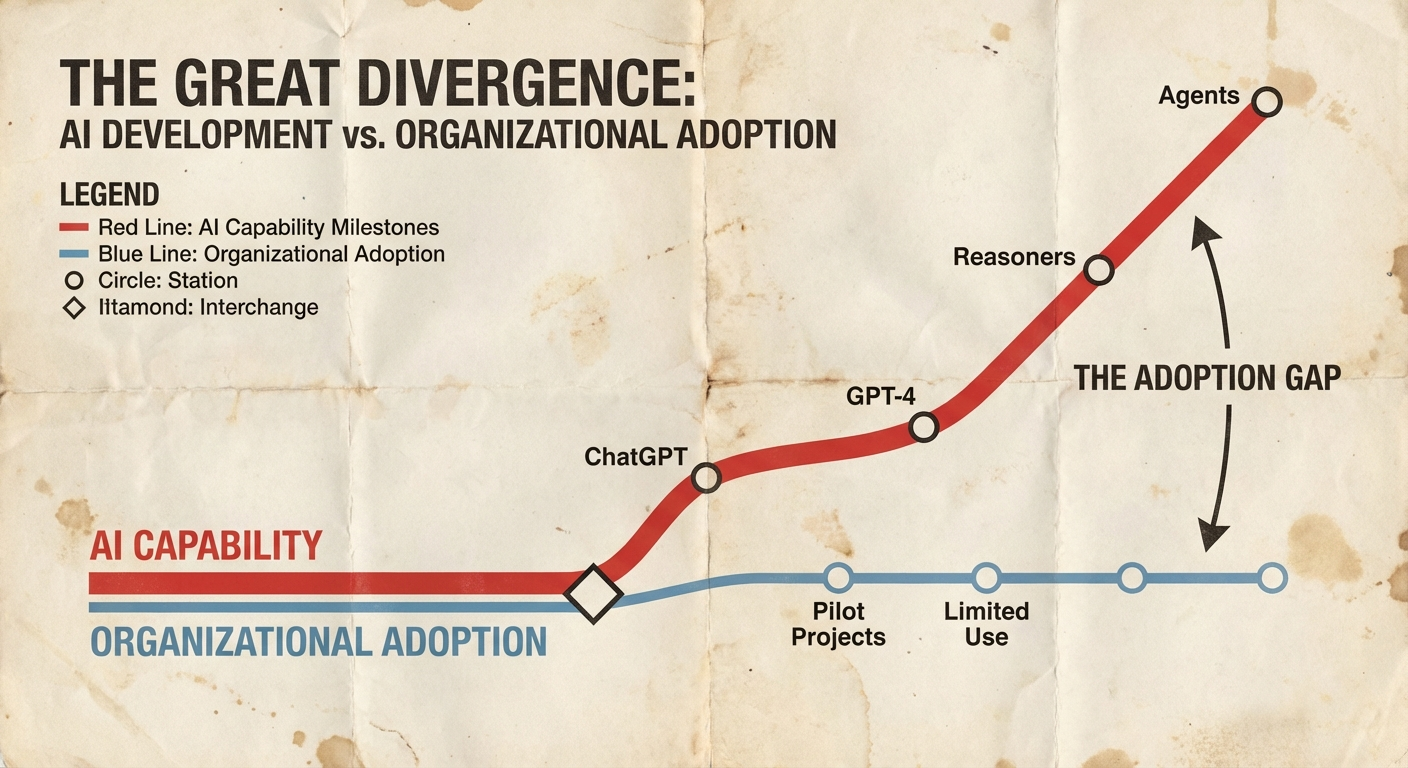
The surface reading is that OpenAI is getting focused. The deeper read is more significant: the most valuable AI company on the planet just told you exactly where it thinks all the value lives. Not in video generation, not in consumer entertainment, not in ads. In work. In automating knowledge work at a scale that, as one observer put it, represents a "largely untapped, roughly $40 trillion-plus market." And OpenAI is not alone in this bet. Both OpenAI and Anthropic are now partnering with consulting firms and private equity shops because they have come to the same conclusion: even if the models are AGI-capable, the hard part is getting organizations to actually deploy them.
Most organizations are still watching the capability race. The labs have already moved on to the deployment race. That gap is where the next twelve months of enterprise AI strategy will be won or lost.
The Side Quest Reckoning
Simo framed the decision with unusual candor for a company that typically speaks in product announcements rather than strategic admissions.
Companies go through phases of exploration and phases of refocus. Both are critical, but when new bets start to work, like we're seeing now with Codex, it's very important to double down on them and avoid distractions.
"Avoid distractions" is doing a lot of work in that sentence. Sora was not some minor experiment. It was unveiled with enormous fanfare, it attracted a partnership with Disney, and it represented OpenAI's most visible push into consumer entertainment. Disney, for its part, had chosen to partner rather than sue, and had been planning a billion-dollar investment. When Sora died, the Disney deal died with it.
The Wall Street Journal reported that some OpenAI staff had been surprised by how compute-hungry the Sora app was relative to the demand it generated. That is a revealing detail. It suggests the decision was not just philosophical but economic: every GPU running Sora was a GPU not running Codex, and Codex was winning customers.
The implications extend beyond video. OpenAI's ad pilot is also struggling. Ad buyers have complained about minimal metrics and the absence of a modern ad sales platform. The instant checkout feature flopped. Shopping is being scaled back. The pattern is clear: everything that is not work is being deprioritized or killed.
Simon Smith of Qlik Health crystallized the arithmetic: why compete for a $680 billion advertising market dominated by incumbents when the largely untapped market of automatable knowledge work is worth roughly $40 trillion? The question answers itself, and OpenAI's actions suggest they agree.
Task AGI Is Here. Job AGI Is Not. That Gap Is Everything.
Jensen Huang was asked on the Lex Friedman podcast when an AI would be able to start, grow, and run a billion-dollar technology company. His answer was revealing not for what he claimed, but for the caveat that followed.
Huang said he thought AGI had already arrived, that it was "not out of the question" that an AI agent could create a novelty web app that billions of people used briefly before it died. He then added: "The odds of 100,000 of those agents building Nvidia is 0%." That is a striking admission from the CEO of the company whose hardware powers most of the world's AI infrastructure. AI can build a novelty app. It cannot build an organization.
The distinction matters enormously for how enterprises should think about AI deployment. What we have right now is something closer to task AGI: almost anything you can ask AI to do that is specific and discrete, it can do well. The problem is that most work consists of strings of tasks woven together, where context shifts, judgment calls compound, and AI capability starts to break down. The jagged frontier of AI capability, the uneven line between what it handles brilliantly and what it botches, runs through the middle of nearly every knowledge worker's day.
Ethan Mollick put it with characteristic precision:
Maybe we should retroactively all just agree with Tyler Cowen that o3 was AGI, so we can stop arguing about it. Doing so will drive home the lesson: AGI alone is not enough for transformation.
This is the uncomfortable truth the labs have been forced to confront. The models are arguably AGI-capable for individual tasks. And yet, as the podcast episode that covered these developments noted, both OpenAI and Anthropic are now actively partnering with consulting and private equity firms because they understand that model capability does not equal organizational transformation. The bottleneck has shifted from building the technology to deploying it inside the messy, political, structurally complex reality of how large organizations actually operate.
The Deployment Gap
OpenAI renaming its product team "AGI Deployment" is not marketing. It is a confession. The word "deployment" is doing the same heavy lifting that "avoid distractions" did in Simo's statement. It acknowledges that the value of AGI-class models is locked behind an organizational barrier that no amount of model improvement will solve on its own.
Consider what deployment actually requires. It requires understanding, at the task level, what each function in an organization does, which of those tasks AI handles well, and which ones it does not. It requires talking to the people doing the work, not just the executives approving the budget, because the jagged frontier runs through their daily routines and they are the only ones who can map it. It requires distinguishing between workflows where AI creates genuine leverage and workflows where it creates the illusion of efficiency while introducing new failure modes.
None of this can be solved with a better model. None of it can be solved with a faster benchmark score. It can only be solved by doing the unglamorous, department-by-department, role-by-role work of figuring out where AI actually creates value inside a specific organization. The labs know this. That is why they are hiring consulting partners. The question is whether the organizations buying AI tools know it too.
What the Labs Just Told You
The convergence is unmistakable. OpenAI killed a high-profile consumer product to redirect resources to enterprise work tools. Anthropic has been focused on knowledge work since Claude Code launched. Both are partnering with consulting firms to solve the deployment problem. Jensen Huang, who has more visibility into AI compute demand than almost anyone alive, drew a bright line between novelty applications and organizational transformation.
Right now more than ever for AI companies, the only type of AGI that matters to them is work AGI.
That statement, from the AI Daily Brief episode covering these developments, captures the moment precisely. The capability race is not over, but the labs have decided it is no longer sufficient. The next phase of competition will be won by whoever cracks deployment at scale, and deployment at scale starts with understanding what work actually looks like inside the organizations that need to change.
The labs have told you where the $40 trillion opportunity lives. The harder question is whether your organization knows where it lives inside your own walls, which tasks AI transforms, which ones it does not, and what your people would tell you if anyone bothered to ask them.